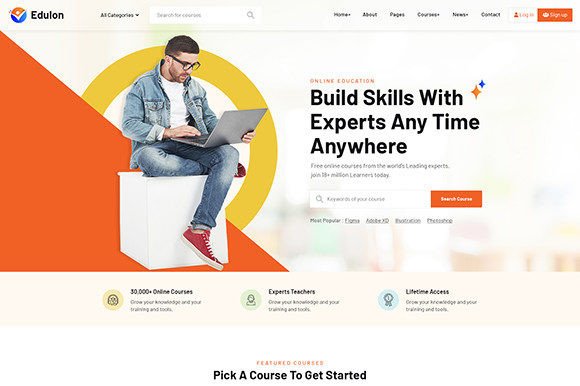
Evaluating the Education and LMS PSD Template for Modern Academic Web Design
In the rapidly evolving landscape of digital education, the visual and functional presentation of an institution’s online presence is as critical as its curriculum. For web designers, developers, and educational administrators, selecting the right foundation for a website is a pivotal decision. The Education and LMS PSD Template has emerged as a notable resource in this space, offering a blend of aesthetic flexibility and technical robustness. This template is designed to serve a wide array of instructional entities, from large universities and colleges to specialized workshops, kindergartens, and direction hubs. Understanding its capabilities, limitations, and ideal use cases is essential for making an informed choice in a crowded market of web design tools.
Core Features and Technical Foundation
At its heart, the Education and LMS PSD Template is built on the widely respected Bootstrap framework. This choice is significant because Bootstrap ensures that the resulting website is inherently responsive. In an era where students and parents frequently access information via smartphones and tablets, a mobile-first approach is not merely a luxury but a necessity. The template guarantees that layouts adjust seamlessly across various screen sizes, maintaining readability and navigational ease whether viewed on a desktop monitor or a small mobile device.
The inclusion of a 1170px grid system further enhances its utility for developers who prefer structured, pixel-perfect designs. This standard grid width allows for ample content space while keeping margins balanced, which is crucial for displaying complex information such as course catalogs, faculty profiles, and event schedules. By adhering to these best practices in web development, the template provides a solid scaffold upon which custom branding and functionality can be layered without compromising structural integrity.
Customizability and Design Flexibility
One of the most compelling aspects of this template is its high degree of customizability. Educational institutions vary wildly in their branding needs. A kindergarten may require bright colors, playful typography, and imagery focused on safety and care, whereas a university might prioritize formal aesthetics, research highlights, and alumni success stories. The Education and LMS PSD Template accommodates this spectrum by providing clean, modular design elements that can be easily adapted.
Designers can modify color schemes, fonts, and layout structures to align with specific institutional identities. Because it is delivered in PSD (Photoshop Document) format, it offers granular control over every visual element before any code is written. This allows stakeholders to visualize the final product accurately, reducing the back-and-forth often seen in web development projects. However, it is important to note that realizing this potential requires a certain level of design proficiency. Those without experience in graphic design software may find the initial setup challenging compared to drag-and-drop website builders.
Comparing Approaches: PSD Templates vs. CMS Themes
When evaluating options for building an educational website, it is helpful to compare PSD templates with pre-built Content Management System (CMS) themes, such as those for WordPress or Joomla. Each approach has distinct tradeoffs regarding cost, time, and control.
- Control and Uniqueness: A PSD template like the Education and LMS option offers greater creative freedom. Since you are starting with a design file rather than a coded theme, you are not constrained by the existing structure of a CMS theme. This is ideal for institutions seeking a unique brand identity that stands out from competitors using popular, off-the-shelf themes.
- Development Time: Using a PSD template typically requires more development time. A developer must convert the design into HTML, CSS, and JavaScript, and then integrate it with a backend system if dynamic content management is needed. In contrast, CMS themes can be installed and configured in hours, making them suitable for projects with tight deadlines or limited technical resources.
- Performance: Websites built from scratch using a clean PSD template and Bootstrap can often achieve better performance scores. Pre-built CMS themes sometimes come with bloated code and unnecessary features that can slow down page load times. For educational sites hosting heavy media or interactive learning modules, a leaner codebase can significantly improve user experience.
Suitability for Different Educational Institutions
The versatility of the Education and LMS PSD Template makes it appropriate for a diverse range of educational settings. However, its fit varies depending on the specific needs of the institution.
Higher Education and Colleges
Universities and colleges often have complex informational architectures. They need to display department details, admission requirements, research publications, and campus news. The structured grid system of this template supports dense information layouts without appearing cluttered. Furthermore, the professional aesthetic aligns well with the academic tone expected by prospective students and faculty members.
K-12 Schools and Kindergartens
For younger educational levels, trust and accessibility are paramount. Parents visiting a school website want to quickly find contact information, calendar events, and safety protocols. The template’s clear navigation and responsive design ensure that busy parents can access critical information on the go. While the default design may lean towards a neutral professional look, the customizable nature allows schools to inject warmth and approachability through imagery and color choices.
Workshops and Training Hubs
Short-term courses, vocational training centers, and workshop organizers benefit from the template’s focus on clarity and conversion. These entities often need to highlight specific courses, instructor credentials, and registration calls-to-action. The layout can be optimized to guide visitors toward signing up for classes, making it a practical choice for commercial educational providers.
Limitations and Considerations
While the Education and LMS PSD Template offers many advantages, it is not a one-size-fits-all solution. Prospective users should carefully consider several limitations before committing to this path.
First, the term "LMS" in the title refers to the design compatibility with Learning Management Systems, not a functional LMS itself. The template provides the front-end interface—the look and feel—but does not include backend functionality for user login, grade tracking, or course progress monitoring. Integrating these features requires additional development work, such as connecting the frontend to platforms like Moodle, Canvas, or custom-built solutions. Organizations expecting a plug-and-play LMS solution may be disappointed and should consider dedicated SaaS LMS platforms instead.
Second, maintenance requires technical expertise. Unlike managed website builders where updates and security patches are handled automatically, a site built from a PSD template requires ongoing manual maintenance. Institutions without an in-house IT team or a retained web developer may struggle with long-term upkeep, security updates, and compatibility issues with new browser versions.
Making the Right Decision
Choosing the right web design resource depends on balancing budget, timeline, and technical capacity. The Education and LMS PSD Template is an excellent choice for organizations that prioritize design uniqueness and performance, and who have access to skilled web developers. It is particularly well-suited for institutions that want to avoid the generic look of mass-market themes and are willing to invest in a custom-coded solution.
Conversely, if an institution needs to launch a website immediately with minimal technical involvement, a hosted website builder or a pre-configured CMS theme might be more appropriate. Similarly, if the primary goal is to deploy a fully functional online learning platform with minimal development effort, a dedicated LMS provider with built-in website tools may offer a more streamlined path.
Ultimately, the value of the Education and LMS PSD Template lies in its foundation. By leveraging Bootstrap and a clean grid system, it provides a professional, responsive, and adaptable starting point. For those willing to invest the necessary development resources, it offers the potential to create a distinctive and high-performing digital presence that effectively serves students, parents, and educators alike. Careful evaluation of your team’s skills and your institution’s long-term digital strategy will determine whether this template is the optimal tool for your project.